


HVAC BASICS
EVERYTHING HOMEOWNERS NEED TO KNOW
Your home's HVAC system is one of its most important — and least understood — features. HVAC stands for Heating, Ventilation, and Air Conditioning. It's the system that keeps you warm in Idaho winters, cool through Boise's hot summers, and breathing clean air year-round. At Ashley Heating Air and Water, we believe an informed homeowner is a better customer — so here's everything you need to know, in plain English.
Free Estimates - Financing - Rebates - Incentives
Expert Installation
WHAT DOES HVAC STAND FOR?
HVAC stands for Heating, Ventilation, and Air Conditioning — the three functions that work together to keep your home comfortable:
-
Heating — furnaces, heat pumps, or boilers that warm your home in cold weather
-
Ventilation — the ductwork, vents, and fans that move air through your home and bring fresh air in
-
Air Conditioning — systems that remove heat from your home's air and cool it down
Most modern homes have a combined system — a furnace or heat pump for heating, a central air conditioner or the same heat pump for cooling, and a network of ducts that distributes conditioned air throughout your home.
The Main Components of Your HVAC System

The Furnace
Your furnace is your home's primary heat source if you have natural gas service. It burns gas to produce heat, then a blower fan pushes that warm air through your home's ductwork. Ashley Heating Air and Water installs Trane furnaces rated up to 96% AFUE — meaning 96 cents of every gas dollar becomes heat in your home.

The Air Conditioner
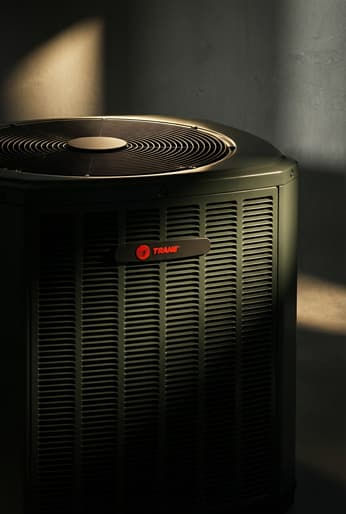
Your air conditioner doesn't actually create cold air — it removes heat from your home's air and moves it outside. The indoor unit (air handler or evaporator coil) absorbs heat from your air; the outdoor unit (condenser) releases that heat outside. A refrigerant circulates between the two, carrying the heat out. Efficiency is measured in SEER2 — the higher the number, the less energy it uses.
The Heat Pump
A heat pump is an all-in-one system that both heats and cools your home — using the same refrigerant-based technology as an air conditioner, but in reverse for heating. In mild weather, heat pumps are remarkably efficient, delivering up to three times more energy than they consume. Ashley Heating Air and Water installs the Trane Premier 20 TruComfort heat pump, which achieves up to 22.4 SEER2.

The Thermostat
The thermostat is your HVAC system's control center. It senses your home's temperature and signals your heating or cooling system to turn on or off. A smart thermostat — like the Trane UX360 installed by Ashley Heating Air and Water — goes much further, learning your schedule, connecting to your smartphone, and enabling remote diagnostics so your technician can monitor your system's health.

The Air Filter
Your air filter sits in the return air duct and captures dust, pollen, pet dander, and other particles before they circulate through your system. It protects both your equipment and your indoor air quality. Most filters need replacement every 30–90 days depending on your home and lifestyle.
WATCH THE VIDEO
HVAC BASICS


Key HVAC terms you should know
SEER2 — Seasonal Energy Efficiency Ratio
Measures air conditioner or heat pump cooling efficiency. Higher is better. Federal minimum is around 14 SEER2; Ashley Heating Air and Water's best system reaches 24 SEER2. Every 1-point increase in SEER2 typically reduces cooling energy use by about 7%.
AFUE — Annual Fuel Utilization Efficiency
Measures furnace heating efficiency as a percentage. An 80% AFUE furnace converts 80 cents of every gas dollar into heat. Ashley Heating Air and Water's Trane Premier 96 reaches 96% AFUE — 20% more efficient than an older 80% unit.
HSPF2 — Heating Seasonal Performance Factor
Measures heat pump heating efficiency. Higher is better. Ashley Heating Air and Water's Trane Priority 17 heat pump achieves up to 11 HSPF2 — among the best available.
BTU — British Thermal Unit
The unit of measurement for heating and cooling capacity. One BTU is the energy needed to raise one pound of water by one degree Fahrenheit. Your system must be sized to match your home's BTU load — too large and it short-cycles; too small and it runs constantly.
Manual J Load Calculation
The industry-standard method for sizing HVAC equipment. It accounts for your home's square footage, insulation, windows, ceiling height, and sun exposure to determine exactly how much heating and cooling capacity you need. Ashley Heating Air and Water performs a Manual J on every new installation — never guessing on size.
MERV Rating
Minimum Efficiency Reporting Value — rates how effectively an air filter captures particles. Higher MERV = finer filtration. Standard 1-inch filters are MERV 4–8. Ashley Heating Air and Water's Trane CleanEffects whole-home air cleaner far exceeds even MERV 16 filters.
HVAC Maintenance
What you can do and what Ashley handles
What you can do at home:
-
Replace your air filter every 30–90 days (more frequently with pets or allergies)
-
Keep the area around your outdoor unit clear of leaves, grass, and debris — allow at least 18 inches of clearance
-
Check that all supply and return vents are open and unobstructed by furniture
-
Set a programmable schedule on your thermostat — the Department of Energy says proper scheduling can save 10%–22% on energy bills
-
Listen for unusual noises — rattling, clicking, grinding, or squealing can indicate problems worth mentioning to your technician
-
Check your circuit breaker if your system stops working — a tripped breaker is a common and simple fix
What Ashley Heating Air and Water handles:
-
Spring cooling tune-up — Ashley checks refrigerant levels, cleans coils, tests electrical components, and ensures your AC is ready for Idaho's heat
-
Fall heating tune-up — Ashley inspects the heat exchanger, tests the gas valve, cleans the burners, and confirms your furnace is safe and efficient
-
Trane Diagnostics enrollment — with a smart thermostat, Ashley can monitor your system's health remotely year-round
-
Duct inspection and cleaning — Ashley removes accumulated dust, debris, and microbial buildup from your air distribution system
-
Filter replacement — Ashley replaces your filter at every maintenance visit and notes the correct size for your system
📅 Seasonal Maintenance Reminder
Schedule your AC tune-up in spring before temperatures climb, and your heating check in fall before the first cold night. Ashley Heating Air and Water customers with smart thermostats get automated maintenance reminders through Trane Diagnostics.
Frequently Asked Questions

Repair or replace your HVAC system
Ashley Heating Air and Water has helped thousands of Boise and Nampa homeowners make this exact decision over more than a century of service. We'll always give you an honest answer — even if that means recommending a repair over a new system. Here's how to think through the decision.
The $5,000 Rule — A Trusted Starting Point
Trane and most HVAC industry professionals use the $5,000 Rule as a quick guideline for repair vs. replacement decisions:
Multiply your system's age (in years) × the estimated repair cost. If the result is under $5,000 → repair is likely the better value. If the result is over $5,000 → replacement is likely worth considering.Example: 10-year-old system × $400 repair = $4,000 → lean toward repairExample: 14-year-old system × $600 repair = $8,400 → lean toward replace
The $5,000 Rule is a starting point — not a final answer. Ashley Heating Air and Water will always consider your specific system, its maintenance history, your energy costs, and how long you plan to stay in your home before making a recommendation. Some older systems are worth repairing; some newer ones warrant replacement. There's no substitute for honest professional guidance.
System Age and Life Expectancy
A well-installed, properly maintained HVAC system should last within these ranges in Idaho's climate:
Typical System Lifestyle
-
Gas furnace: 15–20 years
-
Air conditioner: 12–15 years
-
Heat pump: 15–20 years
-
Air handler: 15–20 years
-
Ductless Mini-Split: 20+ years with maintenance
Ashley's Repair Recommendation (by age):
-
Under 8 years: almost always repair — system has significant life remaining
-
8–12 years: evaluate with $5,000 Rule — depends on repair cost
-
12–15 years (AC) / 15+ years (furnace/heat pump): replacement increasingly makes financial sense
-
Over 15 years (AC) / over 20 years (furnace): replacement is almost always the better long-term value
Clear Signs it's time to replace, not repair
A well-installed, properly maintained HVAC system should last within these ranges in Idaho's climate:
For Air Conditioners
-
System is 12+ years old and needs a repair costing more than $400–$500
-
Refrigerant type is R-22 (Freon®) — this refrigerant is being phased out and is extremely expensive to recharge
-
You've had 3 or more repairs in the last 3 years
-
Your energy bills keep rising even without unusual weather patterns
-
The system can no longer maintain your set temperature on hot days
-
SEER rating is 10 or below — modern systems are dramatically more efficient
For Furnaces
-
Furnace is 15+ years old with an AFUE below 80%
-
Heat exchanger is cracked — this is a safety issue and warrants immediate replacement
-
Frequent cycling — turning on and off repeatedly without reaching set temperature
-
Yellow or flickering burner flame instead of a consistent blue flame
-
Carbon monoxide detector triggered — evacuate and call for emergency service
-
Rooms in your home have dramatically uneven temperatures
For Heat Pumps
-
System is 15+ years old and needs a repair over $500
-
Uses R-22 refrigerant — same phase-out issue as older air conditioners
-
3 or more repairs in the last 3 years
-
Heating or cooling capacity has noticeably declined over time
-
Ice buildup on the outdoor unit that won't defrost
The Energy Efficiency upgrade argument
Sometimes the math on repair vs. replace shifts when you factor in energy savings. Even if a repair is technically the right call by the $5,000 Rule, a significant efficiency upgrade can justify replacement:
Older System Efficiency
-
10-year-old AC: likely 10–13 SEER (old rating)
-
15-year-old furnace: likely 60–80% AFUE
-
Older heat pump: 8–10 SEER and 7–8 HSPF
-
Annual operating cost: significantly higher
New System Efficiency (Ashley Installs)
-
Trane Premier 20 TruComfort AC: up to 24 SEER2
-
Trane Premier 96 Furnace: 96% AFUE
-
Trane Priority 17 Heat Pump: up to 11 HSPF2
-
DOE: replacing old system saves 20–40% on energy bills
For a typical Boise home spending $200/month on heating and cooling, a 30% efficiency improvement saves $720/year — meaning a new system can pay for itself in energy savings alone in 10–12 years, while also delivering significantly better comfort. Ashley Heating Air and Water will model the projected energy savings for your specific home at your free estimate.

Ashley's honest repair vs. repair process
Ashley Heating Air and Water will never push you toward a replacement you don't need. Here's how we approach every repair vs. replace conversation:
-
Ashley's technician performs a full diagnostic — not just the obvious symptom, but the whole system
-
Ashley evaluates your system's age, repair history, efficiency ratings, and current condition
-
Ashley applies the $5,000 Rule and factors in energy savings projections
-
Ashley gives you an honest recommendation — with the full reasoning behind it
-
If replacement is recommended, Ashley provides a written estimate with no obligation
-
If repair is the right call, Ashley makes the repair — without trying to upsell
Our policy: if the repair is the right answer, we say so. If replacing makes more financial sense, we'll show you the math. Either way, Ashley Heating Air and Water's recommendation is backed by 100% written satisfaction guarantee.